
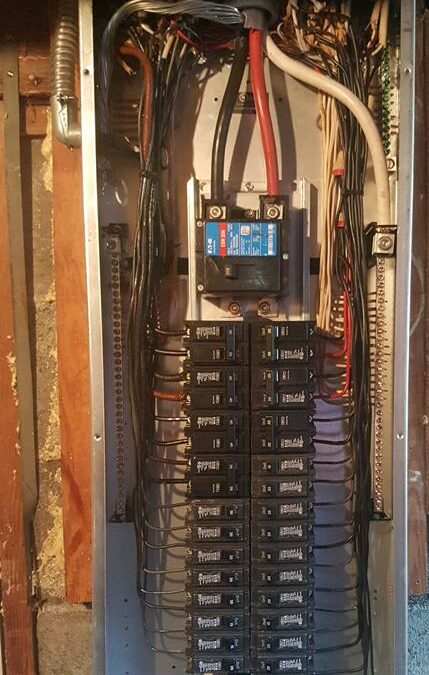
An electrical overload happens when a circuit is asked to carry more current than it was designed to handle. The wiring heats up, insulation begins to degrade, and if the breaker does its job, the circuit shuts off. If the breaker does not do its job, or if the overload is chronic enough to cause damage without tripping the breaker, the result can be a fire that starts inside a wall where no one can see it.
Understanding the common causes of electrical overloads in Vancouver helps homeowners and business owners prevent the conditions that lead to tripped breakers, damaged equipment, and genuine safety hazards.
According to the U.S. Fire Administration, roughly 24,200 residential electrical fires are reported each year across the country, causing an estimated 295 deaths, 900 injuries, and more than $1.2 billion in property damage. Overloaded circuits and extension cord misuse are among the leading contributors to those numbers.
Vancouver, Washington has a housing stock that spans more than a century, from early 1900s homes in the Hough and Arnada neighborhoods to modern construction in Felida and Salmon Creek. Many of these homes, and many of the commercial spaces along Fourth Plain Boulevard and in the Hazel Dell corridor, are running electrical loads that far exceed what the original wiring was built for.
The causes of those overloads are consistent and preventable once you know what to look for.
In this article, you will learn about:
- How circuits become overloaded and why breakers trip
- The household appliances and habits most likely to cause overloads
- How commercial buildings face different overload risks
- Extension cords and power strips as hidden overload contributors
- Outdated panels and wiring that make overloads more dangerous
- Practical steps to prevent overloads in your Vancouver property
Keep reading to find out which everyday habits are putting the most stress on your electrical system and what you can do about each one.
How circuits become overloaded and why the breaker trips
Every circuit in your home or business has a rated capacity, measured in amps, that defines how much current it can safely carry. Most residential circuits in Vancouver homes are rated at either 15 amps or 20 amps. When the combined draw of everything connected to a single circuit exceeds that rating, the circuit is overloaded.
The breaker is the safety valve. It monitors the current flowing through the circuit and trips, cutting power, when the current exceeds the rated amperage for a sustained period. That trip is not a malfunction. It is the breaker doing exactly what it was designed to do, protecting the wiring from overheating.
The problem comes when overloads happen repeatedly, when the breaker is slow to respond, or when the overload is just below the trip threshold but high enough to generate excess heat over time. All three scenarios create conditions where wiring degrades silently inside walls.
The relationship between amps, watts, and circuit capacity
Understanding a few basic numbers helps you recognize when a circuit is approaching its limit. The math is straightforward.
A standard 120-volt, 15-amp circuit can safely deliver a maximum of 1,800 watts (120 volts multiplied by 15 amps). A 20-amp circuit handles up to 2,400 watts. In practice, the National Electrical Code recommends loading a circuit to no more than 80% of its rated capacity for continuous loads. That means:
- A 15-amp circuit should carry no more than about 1,440 watts on a continuous basis
- A 20-amp circuit should carry no more than about 1,920 watts on a continuous basis
Those numbers shrink fast when you start adding up the wattage of common appliances. A space heater draws 1,500 watts. A hair dryer draws 1,200 to 1,800 watts. A window AC unit draws 500 to 1,500 watts. A single space heater on a 15-amp circuit with anything else plugged in, even a lamp, is already at or past the safe limit.
When the load exceeds the circuit’s capacity, the wiring generates more heat than it can dissipate. The Electrical Safety Foundation warns that overloaded circuits are a major cause of residential fires and recommends that all major appliances be plugged directly into wall outlets, never into power strips or extension cords.
What happens when a breaker trips versus when it does not
A properly functioning breaker trips within seconds when the overcurrent is significant, or within minutes when the overload is moderate but sustained. In either case, the circuit shuts off before the wiring reaches a dangerous temperature.
The danger increases in two scenarios:
- The breaker is old, weak, or defective and fails to trip at its rated amperage. This is especially common in older panels where breakers have been tripping and resetting for decades, wearing out the internal mechanism.
- The overload is chronic but just below the trip threshold. A circuit loaded to 90% of capacity may not trip the breaker, but the wiring runs hotter than intended for hours at a time, every day. Over months and years, that excess heat degrades wire insulation and loosens connections, creating the conditions for an arc fault or a fire.
Both scenarios reinforce why simply resetting a tripped breaker without investigating the cause is a mistake. The trip was a message. Understanding and addressing the cause prevents the next one.
How overloads affect wiring inside the wall
When a circuit runs at or above its rated capacity, the current generates heat in the conductor. Copper wire can handle this heat within its rated limits, but above those limits the temperature of the conductor rises, and the insulation surrounding the wire begins to soften, dry out, and eventually crack.
The progression from overloaded circuit to fire hazard follows a predictable sequence:
- Excess current heats the conductor above its normal operating temperature
- The insulation surrounding the conductor absorbs that heat and begins to degrade
- Degraded insulation becomes brittle, cracks, or separates from the conductor
- Exposed or weakened insulation allows the conductor to arc to an adjacent surface, a grounding path, or another conductor
- The arc generates intense localized heat that can ignite surrounding materials
This entire sequence can happen over weeks, months, or years depending on the severity and frequency of the overload. The National Fire Protection Association reports that electrical distribution and lighting equipment are consistently among the leading causes of home structure fires, and wiring is the single most common type of equipment involved.
The invisible nature of this process is what makes overloads so dangerous. By the time a symptom appears on the surface, a burning smell or discoloration around an outlet, significant damage has already occurred inside the wall.
Household appliances and habits that cause the most overloads
Most residential overloads in Vancouver homes are not caused by a single dramatic event. They are caused by everyday habits that put too many high-draw appliances on the same circuit at the same time. Knowing which appliances draw the most power and which combinations are most likely to cause problems is the most practical step you can take.
The wattage ratings listed below are typical ranges. The actual draw of your specific appliance is listed on its nameplate or in the owner’s manual.
Space heaters, hair dryers, and other heat-producing devices
Heat-producing appliances are the single largest contributors to residential overloads because they draw enormous amounts of power relative to other household devices. A portable space heater alone can consume nearly the full capacity of a 15-amp circuit.
The most common high-draw heat-producing devices include:
- Portable space heaters: 750 to 1,500 watts
- Hair dryers: 1,200 to 1,875 watts
- Curling irons and flat irons: 25 to 125 watts (lower individually, but often used on the same bathroom circuit as a hair dryer)
- Toasters and toaster ovens: 800 to 1,500 watts
- Electric kettles: 1,000 to 1,500 watts
- Clothing irons: 1,000 to 1,800 watts
Running any two of these devices on the same 15-amp circuit at the same time will almost certainly exceed the circuit’s safe capacity. In older Vancouver homes where the kitchen and a nearby room may share a circuit, running a toaster and a space heater simultaneously is a recipe for a tripped breaker or, worse, sustained overheating if the breaker is slow.
The fix for these high-draw devices is to ensure each one is plugged directly into a wall outlet on a circuit that is not shared with other high-draw equipment. If that is not possible with the current wiring, a dedicated circuit installed by a licensed electrician eliminates the overload risk.
Kitchen appliances stacked on shared circuits
Kitchens are overload magnets because they concentrate multiple high-draw appliances in a small area, often on fewer circuits than modern code requires. Current code mandates at least two 20-amp small-appliance circuits serving kitchen countertop receptacles, plus dedicated circuits for the refrigerator, dishwasher, and garbage disposal.
Many older Vancouver homes were wired before those requirements existed, leaving the kitchen with a single general-purpose circuit serving everything from the countertop outlets to the overhead light.
Appliances commonly used in kitchens and their approximate wattage include:
- Microwave oven: 600 to 1,500 watts
- Coffee maker: 600 to 1,200 watts
- Toaster or toaster oven: 800 to 1,500 watts
- Electric kettle: 1,000 to 1,500 watts
- Blender or food processor: 300 to 1,000 watts
- Air fryer: 800 to 1,500 watts
- Instant pot or slow cooker: 700 to 1,200 watts
Running a coffee maker and a microwave at the same time on the same 15-amp circuit totals 1,200 to 2,700 watts, well above the 1,440-watt continuous safe limit. Add a toaster and the overload is immediate.
If your kitchen breakers trip during morning routines when the coffee maker, toaster, and microwave all run within minutes of each other, the cause is almost always an undersized or shared kitchen circuit.
HVAC equipment and the inrush current problem
Air conditioners, heat pumps, and electric furnaces are among the highest-draw appliances in any Vancouver home. Central AC units typically draw 15 to 60 amps depending on size, and they should always be on dedicated circuits. But the overload risk from HVAC is not just about steady-state draw. It is about inrush current.
When a compressor motor starts, it draws a brief surge of current that can be three to five times its running amperage. This inrush lasts only a fraction of a second, but it pulls voltage from the rest of the electrical system and can trip breakers on shared circuits or cause lights to dim noticeably.
In homes where the HVAC system shares a panel with a fully loaded kitchen, home office, and entertainment system, the cumulative effect of the HVAC inrush on top of existing loads can push the main service itself toward its limit. This is especially common in homes with undersized 100-amp panels that were installed before central air was standard in the Vancouver area.
How commercial buildings face different overload risks
Commercial buildings in Vancouver face the same fundamental overload physics as residential properties, too much current on too few circuits, but the scale, the equipment involved, and the consequences are different. A tripped breaker at home means resetting the panel. A tripped breaker in a restaurant kitchen during dinner service means lost revenue and potentially spoiled food.
Commercial overloads tend to involve higher-amperage equipment, more complex distribution systems, and load patterns that change throughout the day.
Understanding the specific commercial risks helps Vancouver business owners prevent outages that directly affect operations.
Tenant improvements that outgrow the original wiring
Many commercial spaces in Vancouver are leased by tenants who modify the space to suit their business. A retail space becomes a salon. A general office becomes a tech company with server racks. A storefront becomes a bakery with commercial ovens. Each change increases the electrical demand, and the wiring installed for the original use may not support the new load.
Common tenant-improvement overload scenarios include:
- A restaurant adding commercial kitchen equipment to a space originally wired for retail
- An office adding server racks, multiple workstations, and network equipment on circuits designed for a few desks and lights
- A salon installing multiple high-draw styling stations, dryers, and steamers on circuits rated for general commercial use
- A warehouse converting part of its space to cold storage, adding refrigeration compressors that draw significant continuous power
Each of these scenarios requires an electrical load calculation to determine whether the existing service and distribution can handle the new demand, and an upgrade when they cannot.
Seasonal load spikes in restaurants and retail
Vancouver’s commercial businesses often experience seasonal load spikes that push electrical systems to their limits during the worst possible times.
Restaurants during summer patios and holiday seasons run additional refrigeration, lighting, and cooking equipment. Retail stores during the holiday season add temporary displays, additional point-of-sale terminals, and decorative lighting. Each seasonal increase adds load to a system that may already be running near capacity.
The consequences of a commercial overload include:
- Tripped breakers during peak business hours, causing service interruptions
- Equipment damage from voltage irregularities caused by overloaded circuits
- Food safety risks when refrigeration circuits lose power
- Fire risk from sustained overloading of branch circuits and connections
- OSHA compliance concerns if overloaded circuits lead to hazardous conditions
Planning for seasonal peaks by having an electrician evaluate the system before the busy season helps businesses avoid the disruptions that overloads cause at the worst possible time.
Stacking IT equipment on general-purpose circuits
Modern businesses use significantly more computing and networking equipment than the electrical systems of many Vancouver commercial spaces were designed to support. The Energy Information Administration notes that commercial electricity consumption continues to rise, driven in part by the growing electricity demands of computing equipment across the commercial sector.
A single server rack can draw 2,000 to 5,000 watts or more. Network switches, UPS battery backups, monitors, printers, and workstation computers add hundreds of watts each. When this equipment is plugged into general-purpose 20-amp circuits that also serve lighting and HVAC controls, overloads become inevitable.
IT equipment is also especially sensitive to the voltage irregularities that overloaded circuits produce. Sags, spikes, and fluctuations degrade electronic components and cause premature failure.
Dedicated circuits for server rooms and IT closets, properly distributed across the panel, prevent both the overload risk and the power-quality issues that damage sensitive equipment. For growing Vancouver businesses, planning electrical capacity for IT infrastructure is as important as planning floor space.
Extension cords and power strips as hidden overload contributors
Extension cords and power strips are the most common band-aid solutions for homes and businesses that do not have enough outlets. They appear to solve the problem by providing more places to plug things in, but they do not add any capacity to the underlying circuit. Every device plugged into a power strip still draws from the same circuit, through the same wiring, protected by the same breaker.
The misuse of extension cords and power strips is one of the leading causes of overload-related fires, and it is entirely preventable.
Why power strips do not increase circuit capacity
A power strip with six outlets plugged into a single wall outlet still feeds every connected device through one 15-amp or 20-amp circuit. If the devices collectively draw more than the circuit’s rated capacity, the result is the same overload that would occur if those devices were all somehow plugged directly into the wall.
The illusion that a power strip provides additional power is dangerous because it encourages stacking devices on a single circuit that would otherwise be limited by the number of available outlets.
The Electrical Safety Foundation’s home safety guidance makes clear that power strips add additional outlets but do not change the amount of power being received from the outlet. Heat-producing appliances should never be plugged into power strips, and all major appliances should connect directly to a dedicated wall receptacle.
The right solution when you consistently need more outlets is to have an electrician add additional outlets on new or existing circuits, distributing the load properly rather than concentrating it.
Daisy-chaining extension cords and power strips
Connecting one extension cord to another, or plugging a power strip into another power strip, is one of the most dangerous electrical practices in any building. This daisy-chaining creates excessive resistance in the circuit, generates heat at every connection point, and often allows far more devices to be connected to a single circuit than the wiring can safely support.
Every additional connection in the chain adds resistance. That resistance generates heat, and the heat is concentrated at the plug-and-socket connections rather than distributed evenly along the wiring. The connectors are the weakest point, and they are the point most likely to melt, arc, or ignite.
The USFA topical fire report on residential electrical fires identifies extension cords as the equipment involved in ignition for approximately 5% of residential electrical fires, with roughly 3,300 home fires originating in extension cords each year nationally.
If your Vancouver home or business relies on daisy-chained cords or stacked power strips, this is one of the clearest indicators that the building needs additional circuits to safely support the connected equipment.
The difference between temporary use and permanent installation
Extension cords are designed for temporary use. Plugging a drill into an extension cord while working on a project, then unplugging it when done, is exactly what they are for. Using an extension cord as a permanent power supply for a space heater, a window AC unit, or an entertainment center is a misuse that creates ongoing fire risk.
Signs that extension cords are being used as permanent wiring include:
- Cords running under rugs, through doorways, or along baseboards for weeks or months at a time
- Cords attached to walls, stapled along trim, or threaded through holes in walls
- Cords that are warm to the touch during normal use
- Cords with visible damage, fraying, or exposed conductors
- A cord that has been in the same position for so long that furniture is arranged around it
Each of these conditions creates a fire hazard. A cord under a rug traps heat and is invisible to anyone monitoring for problems. A cord pinched by furniture or stapled to a surface can have its insulation damaged, exposing conductors. A warm cord is operating at or beyond its rated capacity.
The permanent solution is always proper wiring. A licensed electrician can add outlets exactly where they are needed, on circuits with the capacity to support the connected equipment, eliminating the need for extension cords entirely.
Outdated panels and wiring that make overloads more dangerous
An overloaded circuit in a home with modern wiring and a properly functioning panel is a problem that the breaker handles by tripping. The same overload in a home with an aging panel, corroded connections, or undersized wiring is far more dangerous because the safety margins are thinner and the backup systems may not work as designed.
Vancouver’s mix of pre-war homes, mid-century construction, and 1970s-era buildings means that many properties have electrical systems where the margin between safe operation and overheating is already slim before any overload is added.
Panels that are already at capacity
A panel running at or near its rated amperage has no headroom for the momentary surges and inrush currents that happen dozens of times a day. Every time the HVAC compressor kicks on, every time someone starts the microwave, the panel absorbs a brief spike that exceeds steady-state draw.
In a panel with adequate headroom, these spikes are inconsequential. In a panel running at 90% or more of its rated capacity, they push the system to its edge repeatedly, heating bus bar connections and breaker terminals with each spike.
Signs that a panel is at capacity include:
- Every breaker slot is occupied with no room for additions
- The main breaker is rated at 100 amps or less for a home with central HVAC, a full kitchen, and a home office
- Double-tapped breakers or tandem breakers have been installed to squeeze more circuits into a full panel
- The panel door or surrounding wall feels warm to the touch
A panel upgrade to a higher-capacity panel with more breaker spaces addresses the root cause and provides room for both current loads and future additions.
Wiring that cannot handle the load it carries
Even when the breaker and panel are adequate, the branch circuit wiring itself can be a weak link. Older Vancouver homes may have 14-gauge wire on circuits that are now being asked to serve high-draw loads, or wire that has been extended with improper splices that create high-resistance connection points.
Common wiring issues that compound overload risk include:
- Circuits originally wired with 14-gauge copper that now serve loads better suited to 12-gauge or 10-gauge
- Aluminum branch wiring with connections that have loosened over time, creating hot spots at every outlet and switch
- Backstab connections on outlets where wires are push-fit rather than wrapped around screw terminals, prone to loosening under thermal cycling
- Splices made outside junction boxes or without proper wire nuts, creating unprotected connection points that overheat under load
- Wiring that passes through insulated spaces where heat cannot dissipate, increasing the effective temperature of the conductor
Each of these conditions lowers the threshold at which an overload becomes a fire hazard. A circuit that might safely tolerate a brief overload in a home with new wiring and tight connections may overheat in a home where the connections are already generating excess heat from corrosion and looseness.
A professional electrical safety inspection identifies these compounding factors so they can be addressed before they contribute to a failure.
Missing or inadequate overcurrent protection
The breaker is the last line of defense against an overload. When the breaker itself is compromised, either because it is defective, worn out, or the wrong size for the circuit, overloads can persist unchecked.
The most common overcurrent protection problems in Vancouver properties include:
- Oversized breakers installed on circuits with wiring too small for the breaker’s rated amperage (a 20-amp breaker on 14-gauge wire, for example, allows the wire to overheat before the breaker trips)
- Breakers that have tripped and been reset hundreds of times over the decades, weakening the internal trip mechanism
- Federal Pacific or Zinsco panels with documented breaker failure rates that leave circuits unprotected during overcurrent events
- Fuse boxes where the correct fuse has been replaced with a higher-amperage fuse to stop nuisance blowing, a practice that eliminates overcurrent protection entirely
Correcting these problems, whether by replacing individual breakers, upgrading the panel, or having an electrician verify that every breaker matches the wire gauge it protects, restores the safety system that prevents overloads from becoming fires.
Practical steps to prevent overloads in your Vancouver property
Preventing overloads is a combination of awareness, habit changes, and targeted electrical upgrades. Some steps are free and immediate. Others require an electrician and an investment. All of them reduce the risk of tripped breakers, equipment damage, and fire.
Start with the behavioral changes that cost nothing, then move to the upgrades that eliminate the structural causes.
Know what is on each circuit
Most Vancouver homeowners have no idea which outlets, lights, and appliances share a circuit. Mapping your panel, either by turning off each breaker one at a time and noting what loses power, or by having an electrician do it as part of a circuit troubleshooting visit, tells you where the overload risks are.
Once you know the circuit layout, basic load management becomes straightforward:
- Avoid running two or more high-draw appliances on the same circuit at the same time
- Move portable space heaters to circuits that are lightly loaded
- Stagger the use of kitchen appliances rather than running them simultaneously
- Never plug a space heater, window AC unit, or other high-draw device into a power strip or extension cord
These adjustments require no wiring changes and can prevent the majority of residential overloads.
Add dedicated circuits where overloads recur
If a specific area of your home or business consistently trips breakers despite careful load management, the circuit serving that area is simply undersized for the demand. Adding a dedicated circuit solves the problem permanently.
The areas that most commonly need dedicated circuits include:
- Kitchen countertops (current code requires at least two 20-amp circuits)
- Bathrooms (each bathroom should have at least one 20-amp circuit)
- Home offices with computers, monitors, printers, and networking equipment
- Workshops or garages with power tools
- Any location that regularly runs a space heater or window AC unit
- EV charging stations, which typically need a dedicated 40-amp or 50-amp circuit
A licensed electrician can install a dedicated circuit from the panel to the specific area, providing the amperage needed without affecting any other part of the electrical system.
Schedule a load evaluation for your property
The most effective way to prevent overloads across your entire property is a professional load evaluation. The electrician calculates the total demand of everything connected to the system, compares it to the panel and service capacity, and identifies circuits that are at or near their limits.
The evaluation also identifies opportunities to rebalance the load across the panel, moving circuits from one bus leg to the other so that neither side carries a disproportionate share of the demand. Load balancing reduces stress on individual breakers and connections without adding any new wiring.
For Vancouver homes built before the 1990s, this evaluation is especially valuable because the original wiring plan was designed for a fraction of the loads the home now carries. Understanding exactly where the system stands gives you the information to plan upgrades that prevent problems rather than reacting to them after a failure.
Conclusion
Electrical overloads are one of the most common and most preventable hazards in any building. They happen when too many devices draw too much power from too few circuits, and the causes in Vancouver homes and businesses are almost always a combination of aging infrastructure, modern electrical demands, and habits that concentrate too much load in one place.
The warning signs, tripped breakers, warm outlets, dimming lights, and the heavy reliance on extension cords and power strips, are all telling you the same thing. The electrical system is being asked to do more than it can safely handle, and every day that continues without correction is a day the wiring degrades a little further.
If overloads are a recurring problem in your Vancouver property, or if you are unsure whether your electrical system has the capacity to support your current and planned loads, contact Peak Electric Group to schedule a load evaluation. A licensed electrician can identify the specific circuits at risk, recommend targeted upgrades, and help you build a system that handles everything you need safely.
Recent Comments