The lights go out. The refrigerator stops humming. Your Wi-Fi router goes dark and every clock in the house starts blinking. Sudden power loss in a Hillsboro home can happen without any warning, and the first ten seconds are usually spent wondering whether it is just your house or the whole neighborhood.
Understanding the causes of sudden power loss in Hillsboro helps you answer that question quickly and respond correctly. Some causes are on the utility side and will resolve without any action from you. Others are inside your home and will not come back until someone finds and fixes the fault. Knowing which is which saves you from waiting hours for a utility restoration that is never coming, or from calling an electrician for a problem that is already being worked by the power company.
This guide walks you through the full diagnostic path, from the first moment the power drops to the decision point where you either wait or call. It covers utility-side causes, internal electrical faults, and the gray-area scenarios that confuse homeowners most often.
In this article, you will learn about:
- How to tell in the first two minutes whether the outage is yours or the grid’s
- Utility-side causes that affect entire neighborhoods
- Internal causes that only affect your home
- Partial power loss and what it means when half your house goes dark
- Weather, trees, and the external factors that hit Hillsboro hardest
- When to call an electrician instead of waiting for the utility
Keep reading to learn what to check, what to skip, and when to pick up the phone.
How to tell in the first two minutes whether the outage is yours or the grid’s
The fastest way to narrow down the cause of sudden power loss is to check whether anyone else around you lost power at the same time. This single question splits the entire diagnostic into two completely different paths.
Step one: look outside
If your neighbors’ lights are off, their porch lights are dark, and the streetlights on your block are out, the outage is almost certainly on the utility side. You are dealing with a grid event, not a problem inside your home. Check your utility’s outage map online using your phone’s cellular data, report the outage if it has not been reported already, and wait for restoration.
If your neighbors’ lights are on and the streetlights are working, the problem is between the utility’s service point and your home, or inside your home. That is a different situation entirely, and it requires a different response.
Step two: check your main breaker
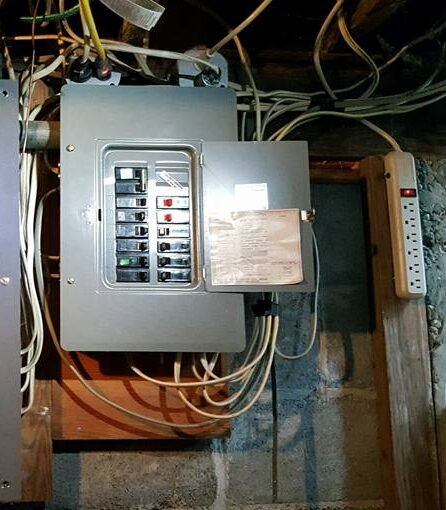
Open your electrical panel and look at the main breaker at the top. If it has tripped, the entire home lost power because the main breaker opened. Reset it by pushing it firmly to OFF first, then back to ON.
If the main breaker holds and power returns, something caused a momentary overload or fault that exceeded the main breaker’s rating. Monitor it. If it trips again within minutes or hours, the cause is still present and a tripped breaker assessment is the next step.
If the main breaker was not tripped and your neighbors have power, the cause may be at the meter, at the service entrance, or at the utility connection to your home. These are conditions that require either the utility or an electrician to diagnose, and they are covered in detail below.
Step three: check for partial power loss
If some lights work and others do not, or if half of your outlets are dead while the other half are live, you have a partial power loss. This is a distinct condition with its own set of causes, and it almost never resolves on its own. Skip ahead to the partial power loss section for the specific diagnosis.
Utility-side causes that affect entire neighborhoods
When the outage extends beyond your property, the cause is on the utility’s side of the meter. These events are outside your control, but understanding what causes them helps you gauge how long the outage is likely to last and whether your home needs attention after power is restored.
Weather events and the Pacific Northwest wind pattern
The Hillsboro area is subject to seasonal wind events, ice storms, and heavy rain that stress the overhead distribution system. According to the U.S. Energy Information Administration, U.S. electricity customers experienced an average of 11 hours of power interruptions in 2024, nearly double the annual average across the previous decade, with major weather events accounting for 80% of those lost hours.
While Oregon does not face the hurricane risk that drove those national numbers, the Pacific Northwest wind corridor regularly produces sustained winds and gusts that bring down trees and branches onto overhead power lines. A single tree limb across a distribution line can knock out power to hundreds of homes simultaneously.
Ice storms are the other major weather threat. Freezing rain coats power lines with a layer of ice that adds weight and catches wind, snapping lines and breaking poles. Restoration after an ice storm takes longer than after a wind event because the damage is typically more widespread and crews must wait for conditions to improve before working on elevated lines.
Transformer failures and equipment aging
The transformer that serves your home or your block converts higher-voltage distribution power to the 240-volt service your panel receives. Transformers fail from age, overloading, lightning strikes, and internal insulation breakdown. When a transformer fails, every home it serves loses power simultaneously.
Transformer replacements are utility work and typically take several hours. If your outage is localized to a small cluster of homes and the utility confirms a transformer failure, expect a longer restoration window than a simple line repair.
Planned outages you were not expecting
Utilities occasionally schedule outages for maintenance, line upgrades, or equipment replacement. These are supposed to be communicated in advance, but notification does not always reach every affected customer. If your power drops during a weekday with clear weather and your neighbors are also dark, check your utility’s website or call their outage line to see if the outage is planned.
Internal causes that only affect your home
When your neighbors have power and you do not, the fault is somewhere between the utility’s connection point and the circuits inside your walls. These causes range from simple breaker trips to serious wiring faults, and they almost always require some level of diagnosis to resolve.
A tripped main breaker
The main breaker protects the entire panel and everything downstream of it. It trips when the total load on the home exceeds its rating or when a fault on any circuit produces enough current to trigger the main rather than the branch breaker.
A main breaker trip that happens once during an unusual load event, like running the AC, dryer, and oven simultaneously on a hot day, is a capacity issue. A main breaker trip that happens under normal load conditions or that repeats after resetting is a fault condition that needs professional diagnosis. The fault may be in the panel itself, in the wiring between the panel and the meter, or on a branch circuit where the branch breaker failed to trip first.
If your main breaker will not hold a reset, do not keep trying. According to the NFPA, home electrical fires involving electrical failure or malfunction cause an estimated average of 527 civilian deaths, 1,580 injuries, and $2.4 billion in property damage per year. A main breaker that will not hold is telling you the fault is active, and repeated resetting forces the breaker through mechanical stress that can cause it to fail open in a future event.
A failed main breaker that did not trip visibly
A main breaker can fail internally without moving its handle to the tripped position. The contacts inside the breaker may have welded, pitted, or corroded to the point where they no longer carry current, but the handle stays in the ON position because the mechanical linkage is separate from the electrical contacts.
This condition is confusing because the panel looks normal. The main breaker appears to be on, no branch breakers have tripped, but the entire home has no power. If you encounter this, the breaker itself has failed and needs replacement. This is a job for a licensed electrician, not a reset attempt. A breaker panel replacement evaluation will determine whether replacing the main breaker alone is sufficient or whether the panel should be replaced entirely.
A service entrance or meter base failure
The wiring between the utility’s connection and your panel, which includes the meter base, the service entrance cable, and the main disconnect if one exists, can fail from corrosion, physical damage, or age. A corroded meter base connection, a damaged service entrance cable, or a failed main disconnect will cut power to the entire home even though the utility’s service is live at the weatherhead.
Meter base and service entrance work falls in a gray area between utility and homeowner responsibility. The utility owns the meter itself, but the meter base, the service entrance cable, and the panel are the homeowner’s responsibility. If your main breaker is not tripped and the utility confirms their service is live, the fault is likely in this section. An electrician experienced with emergency electrical repair can diagnose and repair service entrance failures, coordinating with the utility for meter removal and reinstallation as needed.
Partial power loss and what it means when half your house goes dark
Partial power loss, where some circuits work and others do not, is one of the most confusing conditions a homeowner can face. It does not fit the simple “power is on or off” mental model, and its causes are specific and worth understanding.
Lost neutral: the most common cause of partial power loss
Your home receives power on two 120-volt legs that combine to provide 240 volts for large appliances. The neutral conductor balances the load between these two legs. When the neutral connection fails, whether at the utility’s transformer, at the weatherhead, or at the panel, the two legs become unbalanced.
The result is that some circuits receive too much voltage and others receive too little. Lights on one half of the panel may be abnormally bright while lights on the other half are dim or off. This condition is dangerous because the overvoltage on the bright side can damage appliances and electronics.
If you notice lights that are unusually bright on some circuits while other circuits are dead, turn off or unplug sensitive electronics immediately and call an electrician. A lost neutral is an urgent repair, not a wait-and-see situation. Partial power outage troubleshooting for a lost neutral condition involves testing at the panel, at the meter base, and potentially at the utility connection to isolate where the neutral failed.
One leg of the service lost at the transformer or weatherhead
A utility connection that loses one of the two legs produces a similar symptom to a lost neutral. Half of your circuits go dead while the other half continue to work normally. The difference is that you will not see overvoltage on the working side because the neutral is still intact.
This cause is sometimes intermittent, especially if the connection at the weatherhead is loose rather than fully failed. Wind can push the service entrance cable enough to break and remake a marginal connection, producing power loss that comes and goes. If your partial power loss seems to correlate with windy conditions, a loose connection at the weatherhead is a strong possibility.
A failed double-pole breaker serving a 240-volt circuit
A 240-volt circuit, like the one serving your electric range, dryer, or heat pump, uses a double-pole breaker that connects to both legs of the service. If one pole of that breaker fails internally, the appliance it serves will either stop working entirely or operate abnormally, such as an electric dryer that tumbles but does not heat.
This cause is limited to the specific circuit served by the failed breaker and does not affect other circuits on either leg. If a single 240-volt appliance has stopped working while everything else in the house is fine, the double-pole breaker serving that circuit is the first thing to check.
Weather, trees, and the external factors that hit Hillsboro hardest
Hillsboro’s location and tree cover create specific external risk factors for sudden power loss that are worth understanding, especially if you are deciding whether to invest in preventive measures or backup power.
The fall and winter wind season
The Willamette Valley wind corridor channels Pacific storms through the Portland metro area from late October through March. Hillsboro sits at the western edge of this corridor, and its tree-lined residential streets are particularly vulnerable to wind-driven branch failures that take down overhead service lines.
A tree branch that falls across the service entrance cable to your home can tear the weatherhead off the building, snap the mast, or pull the meter base off the wall. Any of these conditions requires an electrician to repair the homeowner’s side of the service entrance before the utility will reconnect power. Having the condition of your service entrance checked periodically, especially if you have mature trees near the service drop, can catch a weathered mast or loose connection before a storm turns it into an emergency.
Ice loading on service entrance cables
Freezing rain is less common in Hillsboro than in the Columbia River Gorge, but it does occur. Ice loading on the service entrance cable, the span between the utility pole and your home, adds weight that the cable and its attachment points were not designed to carry continuously. A heavy ice event can pull the weatherhead loose or snap the mast, dropping the service entrance cable to the ground.
If you find a downed service entrance cable after a storm, stay away from it. Even if your power is out, the utility side of the cable may still be energized. Call the utility first to confirm the line is de-energized, then call an electrician to assess and repair the damage on your side.
Summer heat events and peak load stress
Hillsboro’s summer heat events, while not as extreme as Arizona or Texas, push residential electrical loads higher than winter norms. The combination of AC compressors, fans, and refrigerators running continuously during a heat wave stresses panels and breakers that had plenty of capacity during moderate weather.
According to ENERGY STAR, older homes that do not have central AC often have only a 100-amp panel, and adding high-draw equipment may exceed the panel’s safe operating capacity. A heat event that pushes the total load past a 100-amp panel’s comfortable range can trip the main breaker, producing a sudden total power loss that looks like a utility outage but is actually an internal capacity issue. If your home loses power during a heat event while your neighbors’ power stays on, the panel’s capacity is the first place to look.
When to call an electrician instead of waiting for the utility
The decision to call an electrician versus wait for the utility depends on one question: is the problem on your side of the meter or theirs? Here is how to decide.
Call the utility first if the whole neighborhood is dark
If the outage is widespread, report it to your utility and wait. There is nothing an electrician can do about a downed distribution line or a failed transformer. Save the electrician call for after power is restored if you notice anything abnormal with your system once the utility’s service is back.
Call an electrician if your neighbors have power and you do not
This means the fault is between the utility’s connection and your panel, or inside your panel. An electrician can diagnose and repair service entrance failures, main breaker failures, and internal panel faults. If the problem turns out to be on the utility side of the meter, the electrician can confirm that and direct you to the utility with specific information about the failure location.
Call an electrician immediately for partial power loss
Partial power loss, especially with lights that are unusually bright on some circuits, suggests a lost neutral or a failed leg of the service. Both conditions can damage electronics and appliances on the overvoltage side. Turn off or unplug sensitive equipment and call an electrician for urgent diagnosis. A residential electrical repair provider can isolate the failure point and either correct it on the homeowner’s side or coordinate with the utility for a repair on their side.
Call an electrician if power returns but something is wrong
After a utility restoration, voltage irregularities during the reconnection sequence can damage equipment that was operating normally before the outage. If you notice that an appliance is not working correctly after power returns, a breaker has tripped that was not tripped before, or you smell something burning near the panel, have an electrician check the system before you resume normal use.
What to note before calling an electrician after a power event:
- Whether the outage was total or partial
- Which circuits lost power and which did not
- Whether any breakers tripped, and which ones
- Whether lights were unusually bright or dim during the event
- Whether any burning smell, sparks, or unusual sounds occurred at the panel
- Whether any appliances are behaving abnormally since power returned
Invest in surge protection and a backup plan before the next event
Hillsboro’s wind, ice, and heat exposure means power events are not a question of if but when. Power surge protection installed at the panel protects your electronics and appliances from the voltage transients that occur during utility restoration. A backup generator keeps critical systems running during extended outages. Both are far less expensive than the equipment damage and food spoilage they prevent.
Conclusion
Sudden power loss in a Hillsboro home is always unexpected, but it does not have to be confusing. The diagnostic path is logical. Check your neighbors first, then check your main breaker, then check for partial loss. Those three steps in the first two minutes tell you whether to call the utility, call an electrician, or wait.
The causes range from utility-side events like weather damage and transformer failures that affect entire neighborhoods to internal causes like tripped main breakers, failed service entrance connections, and panel-level faults that affect only your home. Partial power loss, where half the house goes dark while the other half stays on, is its own category and often points to a lost neutral or a failed service leg that requires urgent professional attention.
Hillsboro’s wind corridor, ice risk, aging housing stock, and growing residential electrical loads all contribute to a baseline of power loss risk that is manageable with the right preparation. Knowing what to check, knowing when to call, and having surge protection and a backup plan in place turns an emergency into an inconvenience.
Contact Peak Electric Group to schedule an electrical assessment and make sure your home is ready for the next power event before it happens.
Recent Comments