
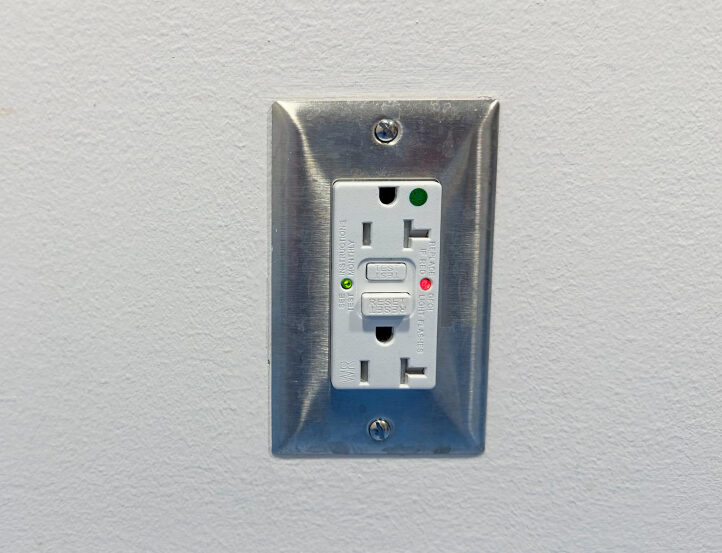
A ground fault circuit interrupter does one thing, and it does it faster than any other protective device in your home. When electricity leaks from its intended path, whether through water, a damaged cord, or a person, a GFCI detects the imbalance and cuts power in about one-thirtieth of a second. That speed is the difference between a brief tingle and a fatal shock.
The benefits of GFCI outlets in Vancouver homes extend beyond the shock protection itself. GFCIs bring older homes into compliance with current electrical code, protect downstream outlets on the same circuit, reduce the risk of electrical fires caused by ground faults, and give homeowners a testable, verifiable layer of safety that no other device provides.
This guide explains how GFCIs work, where they are required, why Vancouver’s housing stock and climate make them especially important, and what every homeowner should know about testing, maintaining, and upgrading GFCI protection throughout the home.
In this article, you will learn about:
- What a GFCI does and why it matters more than a standard breaker
- Where GFCIs are required by code and where they should be even if they are not
- How GFCIs have changed the electrocution statistics in the United States
- Why Vancouver’s wet climate makes GFCI gaps more dangerous
- How to test your GFCIs and what a failed test means
- When to replace aging GFCIs and when to upgrade to GFCI breakers
Keep reading to understand the single most effective shock-prevention device in your home.
What a GFCI does and why it matters more than a standard breaker
A standard circuit breaker protects wiring from overheating by tripping when the current on a circuit exceeds its rated capacity. It does not protect people. A GFCI does. Understanding the difference between the two explains why a home can have every breaker working perfectly and still have a lethal shock hazard at any unprotected outlet near water.
The physics of a ground fault in plain language
Electricity flows in a loop. Current leaves the panel on the hot wire, passes through whatever device is plugged in, and returns on the neutral wire. In a properly functioning circuit, the current on the hot wire exactly matches the current on the neutral wire.
A ground fault occurs when some of the current finds an unintended path to ground instead of returning on the neutral. That path might be through water pooled around a bathroom outlet, through a damaged cord insulation that lets current reach the metal housing of an appliance, or through a person who is touching a live device and a grounded surface at the same time.
The amount of current that leaks through a ground fault is often too small to trip a standard breaker. A breaker rated for 15 amps will not react to a 30-milliamp ground fault. But 30 milliamps flowing through a person’s chest is enough to cause cardiac arrest. The GFCI closes that gap.
How the GFCI detects and stops the fault
A GFCI continuously compares the current on the hot wire to the current on the neutral wire. When those two values differ by as little as 4 to 6 milliamps, the GFCI trips and cuts power to the outlet in approximately one-thirtieth of a second.
That response time and that sensitivity level are what make GFCIs effective. A person who contacts a ground fault on a GFCI-protected circuit may feel a brief shock, but the GFCI removes power before the current can reach dangerous levels. Without GFCI protection, the same fault delivers continuous current until the person lets go, someone else cuts the power, or the outcome becomes fatal.
Why a standard breaker cannot do this job
A standard breaker detects overcurrent, meaning it trips when total current on the circuit exceeds the breaker’s rating. A ground fault does not necessarily produce overcurrent. If you are standing in a wet bathroom and touch a live appliance, the current flowing through your body might be 20 to 100 milliamps. The breaker sees 15 amps total on the circuit and does nothing because the circuit is not overloaded. The fault current is tiny relative to the circuit’s capacity, but it is more than enough to kill.
This is the fundamental reason every wet or damp location in a home needs GFCI protection regardless of whether the circuit already has a standard breaker protecting it.
Where GFCIs are required by code and where they should be even if they are not
The National Electrical Code has expanded GFCI requirements over decades, adding locations as the data on electrocution incidents demonstrated where the hazards were greatest. Older Vancouver homes that have not been updated may be missing GFCI protection in locations where the code now mandates it.
The current NEC requirement list
The NEC requires GFCI protection on receptacle outlets in the following locations:
- All bathroom receptacles
- Kitchen countertop receptacles within six feet of a sink
- All receptacles serving countertop surfaces in kitchens
- Garage receptacles, both finished and unfinished
- All outdoor receptacles
- Crawl space receptacles at or below grade
- Unfinished basement receptacles
- Laundry area receptacles
- Receptacles within six feet of a sink in any location, including bars and utility areas
- Boathouse receptacles
- Receptacles serving dishwashers
This list has expanded significantly since the first GFCI requirement appeared in 1971 for swimming pool equipment. A home built in the 1980s may have GFCI protection in bathrooms but not in the kitchen, garage, or outdoor locations. A home built before 1975 may have no GFCI protection anywhere.
Locations where GFCIs are not required but should be considered
Some locations are not on the NEC’s mandatory list but carry similar moisture or shock risk. These include:
- Receptacles near indoor water features or fish tanks
- Workshop outlets where power tools are used with wet or damp hands
- Receptacles in finished basements that were converted from unfinished space
- Outlets near utility sinks or water heaters
- Bedroom outlets in homes with young children, where GFCI protection adds an extra safety margin
Adding GFCI protection to these locations is not a code requirement, but it is a practical safety improvement that costs very little relative to the protection it provides. An electrical safety upgrade that includes GFCI expansion beyond the minimum code requirement is one of the highest-value improvements a homeowner can make.
How GFCIs have changed the electrocution statistics in the United States
GFCI protection is not a theoretical benefit. It has a documented, measurable track record of reducing electrocution deaths since it was first introduced in the early 1970s.
The numbers before and after GFCI adoption
Before GFCIs became standard, roughly 800 people per year died from consumer product-related electrocution in and around the home. According to the CPSC, that number has dropped to approximately 200 per year, a reduction of more than 75% that coincides directly with the progressive adoption of GFCI requirements in residential electrical codes since 1971.
The CPSC has stated that if every household installed GFCI protection on all required circuits, deaths from electrocution in and around the home could be reduced by half from current levels. That estimate comes from a CPSC analysis that found many electrocution deaths still occur on circuits where GFCI protection is absent, often in older homes that predate the code requirements.
What those numbers mean for Vancouver homeowners
Vancouver’s housing stock includes a substantial number of homes built before GFCI requirements covered kitchens, garages, and outdoor outlets. In these homes, the outlets where ground faults are most likely to occur, near water, in damp spaces, and on exterior walls, may have no protection beyond a standard breaker that cannot detect the fault.
Adding GFCI protection to these locations is not a cosmetic upgrade or a code technicality. It is a direct reduction in the probability of a fatal or serious electrical shock event in your home. The devices cost a fraction of what most home improvements cost, and they provide protection that no other device in your electrical system can replicate.
Why Vancouver’s wet climate makes GFCI gaps more dangerous
Vancouver sits in one of the wettest regions in the continental United States. That moisture interacts with electrical systems in ways that increase the probability and severity of ground faults, making GFCI protection more important here than in drier climates.
Moisture creates the ground fault path
A ground fault requires a conductive path between the live conductor and ground. In a dry environment, air provides excellent insulation and most accidental contact scenarios do not produce a dangerous ground fault. In a wet environment, water provides the conductive path.
Wet hands, damp floors, moisture inside an outlet box, condensation on a tool or appliance housing, and standing water in a crawl space or garage are all conductive paths that turn a minor insulation failure into a serious shock hazard. Vancouver’s extended wet season, with over 150 days of measurable precipitation per year, means these conditions exist for roughly half the year.
Outdoor outlets are exposed to sustained moisture
Outdoor receptacles on porches, patios, and exterior walls sit in the weather for months at a time during Portland and Vancouver’s wet season. Even with weatherproof covers, moisture migrates into outlet boxes through conduit entries, around gaskets, and through cracks in aging covers.
An outdoor outlet without GFCI protection in a Vancouver home is a shock hazard waiting for the right combination of moisture and contact. A GFCI on that circuit catches the ground fault the instant it occurs, regardless of how the moisture got in. Without it, the fault delivers continuous current until something external breaks the circuit.
Garages and crawl spaces are chronically damp
Attached garages and crawl spaces in Vancouver homes are rarely conditioned and frequently sit at or near ground moisture levels. Electrical outlets in these spaces may be used for power tools, battery chargers, shop vacuums, and other devices that are handled with wet or dirty hands in environments where the floor itself is a conductive path to ground.
According to the CPSC, expanding GFCI coverage to additional circuits in the home could prevent 75 to 88 electrocution deaths per year, and the agency found GFCI protection to be 81% to 95% effective in preventing electrocution deaths on protected circuits. Garages and crawl spaces are among the locations where that expanded coverage has the highest impact.
How to test your GFCIs and what a failed test means
A GFCI is a mechanical and electronic device with a finite lifespan. It can fail in a way that allows the outlet to continue delivering power while no longer providing ground fault protection. The only way to know whether your GFCIs are still protecting you is to test them.
The monthly test procedure
Testing a GFCI takes 30 seconds and should be done once a month:
- Plug a lamp or phone charger into the GFCI outlet and verify it is receiving power
- Press the TEST button on the face of the outlet
- The power to the outlet should cut off immediately, and the lamp or charger should go dead
- Press the RESET button to restore power
- Verify the device is live again
If pressing TEST does not cut power, the GFCI has failed and is no longer providing protection. If pressing RESET does not restore power, the GFCI may have failed in the tripped position. Either condition means the device needs replacement.
What causes a GFCI to fail
GFCIs fail from age, moisture exposure, power surges, and cumulative wear from repeated tripping. A GFCI that has been protecting an outdoor circuit through ten Vancouver winters has absorbed significant moisture and thermal cycling, and its internal sensing circuitry may have degraded below the threshold where it can detect a fault.
The Electrical Safety Foundation International recommends testing GFCIs monthly and replacing them when they fail their test. The CPSC’s original GFCI fact sheet notes that if a GFCI does not trip when tested, it is defective and should be replaced. There is no repair for a failed GFCI. The device must be replaced with a new one.
A GFCI that passes its test today may fail tomorrow
GFCI manufacturers and safety organizations recommend replacing GFCIs every 10 to 15 years even if they still pass their monthly test. The internal components degrade with age, and a device that passes today may fail the next time a genuine ground fault occurs. If your GFCIs are original to a home built in the early 2000s or older, proactive replacement is a reasonable step even before a test failure.
When to replace aging GFCIs and when to upgrade to GFCI breakers
Replacing a GFCI outlet is straightforward for an electrician and provides another decade or more of protection. In some situations, upgrading from GFCI outlets to GFCI breakers at the panel provides broader protection with less maintenance.
GFCI outlet replacement: the standard approach
The most common GFCI upgrade is a one-for-one replacement of the outlet device. The electrician removes the old GFCI, installs a new one, and tests it under load. This is the appropriate approach when the existing GFCI location is correct and the circuit wiring is in good condition.
GFCI outlets offer one advantage over GFCI breakers: the TEST and RESET buttons are at the point of use, where the homeowner can reach them easily. For outlets that protect downstream receptacles on the same circuit, the GFCI outlet also provides visual confirmation of its status, since a tripped GFCI outlet is immediately apparent when you try to plug something in.
GFCI breakers: broader protection from the panel
A GFCI breaker installed at the panel protects the entire circuit from the panel outward, including the wiring between the panel and the first outlet. This provides a degree of protection that a GFCI outlet at the first receptacle position cannot, because the GFCI outlet only monitors current from its position downstream.
GFCI breakers are a good choice when:
- The circuit serves multiple wet or damp locations
- The first outlet on the circuit is difficult to access for testing
- The existing wiring makes it impractical to install a GFCI outlet at the correct position
- The homeowner wants to consolidate ground fault protection at the panel for easier maintenance
A residential electrical panel upgrade that includes GFCI breakers on all required circuits provides comprehensive protection and simplifies testing to a single location at the panel.
Combining GFCI and AFCI protection
Modern electrical code requires both GFCI and AFCI protection on certain circuits. AFCI breakers detect arc faults that can cause fires, while GFCIs detect ground faults that can cause shock. Dual-function breakers that provide both AFCI and GFCI protection in a single device are now available and are increasingly specified for new construction and major renovations.
According to the NFPA, home electrical fires account for approximately 13% of all home structure fires and 18% of home fire deaths each year. Combining arc fault and ground fault protection on the same circuit addresses both the fire risk and the shock risk from a single device, which is the most comprehensive protection available for residential circuits.
If your home is due for a panel upgrade or a significant wiring project, specifying dual-function breakers on all applicable circuits provides the highest level of protection for the investment.
How GFCI upgrades fit into a broader electrical safety plan
GFCI installation rarely exists in isolation. It is one component of a broader electrical safety profile that includes grounding, panel condition, wiring integrity, and surge protection. Addressing GFCIs as part of a comprehensive assessment produces better results than treating them as a standalone task.
GFCIs on ungrounded circuits
Older Vancouver homes with two-prong outlets have no ground conductor on those circuits. The NEC permits installing a GFCI outlet on an ungrounded circuit as a shock-protection upgrade, even though the circuit remains ungrounded. The outlet must be labeled “No Equipment Ground” to indicate that while ground fault protection is present, the grounding path that three-prong devices expect is not.
This is a code-compliant improvement that adds genuine protection, but it is a partial solution. The circuit still lacks the grounding path that protects equipment from voltage surges and that some devices need to operate safely. A home rewiring that adds a ground conductor to ungrounded circuits provides both the shock protection and the equipment grounding in a single scope.
GFCI installation during kitchen and bathroom renovations
Kitchen and bathroom renovations that include electrical work must bring the affected circuits up to current code, which includes GFCI protection on all required receptacles. If you are planning a renovation that touches the electrical system in either room, budgeting for GFCI upgrades as part of the project scope is both a code requirement and a practical safety improvement.
Your electrician can advise whether GFCI outlets at the point of use or GFCI breakers at the panel are the better approach for your specific layout. Residential electrical repair services that include GFCI upgrades are routine and can typically be completed during the same visit as other renovation electrical work.
Annual GFCI testing as part of seasonal maintenance
GFCI testing should be part of your regular home maintenance routine, not something you do once and forget. A monthly press of the TEST and RESET buttons takes seconds per device and confirms that every protected circuit is still providing the shock protection it is designed to deliver.
Pairing your annual GFCI check with a broader home electrical safety inspection gives an electrician the opportunity to test GFCI function under load, verify downstream protection is working, and identify any devices that are nearing end of life. This combination of homeowner testing and professional verification provides the most reliable GFCI maintenance program.
Conclusion
GFCI outlets are the single most effective protection against electrical shock in a residential setting, and their track record is documented in the data. Consumer product-related electrocution deaths have dropped from roughly 800 per year to about 200 since GFCI requirements were introduced, and the CPSC estimates that universal GFCI adoption could cut the remaining toll in half.
For Vancouver homeowners, the wet climate, the aging housing stock, and the number of homes built before GFCI requirements covered kitchens, garages, and outdoor locations make this upgrade more urgent than in drier or newer markets. Every unprotected outlet near water is a gap in your home’s safety profile, and closing that gap costs a fraction of what most home improvements cost while providing protection that literally saves lives.
Test the GFCIs you have monthly. Replace any that fail their test. Add GFCI protection to every location where the code requires it and to any location where moisture and electricity are likely to meet. And if your home was built before the mid-1990s, assume that your GFCI coverage has gaps until a licensed electrician confirms otherwise.
Contact Peak Electric Group to schedule a GFCI evaluation and find out exactly where your home’s ground fault protection stands.
Recent Comments